Science is Ready for Consciousness: Federico Faggin
In this fascinating interview Federico Faggin, designer of the first commercial microprocessor and pioneer in the movement to base mathematical theory on consciousness, urges science to embrace consciousness to explain the weirdness of quantum physics, and use it as the instrument of scientific investigation. "There need no longer be a duality between mind and matter," he says. "With consciousness you can reach reality from the inside." He makes a startling suggestion - that matter is the ink with which consciousness writes its own self-knowing.

A (very) Brief History of Certainty
The future is uncertain; this is true for the nature we describe and this is true on the level of our own existence. But this uncertainty is at the very heart of human creativity. Time becomes 'construction' and creativity a way to participate in this construction.

Time, Chaos and the Laws of Physics: A 1995 Dialogue
One of the overall conclusions of a rich day was that we are not at the end of physics, but rather at the end of predictability and certainty, which means including novelty and creativity. And a science in which creativity and participation in the construction of the world are intrinsic is a science, which overcomes the widespread alienation associated with the traditional scientific outlook. In Prigogine's 'new rationality', probability will no longer be seen as ignorance or science as equivalent to certainty. Time is real and the future is open: we live not simply in an 'open society' but also in an open universe.
Science is Ready for Consciousness: Federico Faggin
In this fascinating interview Federico Faggin, designer of the first commercial microprocessor and pioneer in the movement to base mathematical theory on consciousness, urges science to embrace consciousness to explain the weirdness of quantum physics, and use it as the instrument of scientific investigation. "There need no longer be a duality between mind and matter," he says. "With consciousness you can reach reality from the inside." He makes a startling suggestion - that matter is the ink with which consciousness writes its own self-knowing.
A (very) Brief History of Certainty
The future is uncertain; this is true for the nature we describe and this is true on the level of our own existence. But this uncertainty is at the very heart of human creativity. Time becomes 'construction' and creativity a way to participate in this construction.
Time, Chaos and the Laws of Physics: A 1995 Dialogue
One of the overall conclusions of a rich day was that we are not at the end of physics, but rather at the end of predictability and certainty, which means including novelty and creativity. And a science in which creativity and participation in the construction of the world are intrinsic is a science, which overcomes the widespread alienation associated with the traditional scientific outlook. In Prigogine's 'new rationality', probability will no longer be seen as ignorance or science as equivalent to certainty. Time is real and the future is open: we live not simply in an 'open society' but also in an open universe.
Science is Ready for Consciousness: Federico Faggin
In this fascinating interview Federico Faggin, designer of the first commercial microprocessor and pioneer in the movement to base mathematical theory on consciousness, urges science to embrace consciousness to explain the weirdness of quantum physics, and use it as the instrument of scientific investigation. "There need no longer be a duality between mind and matter," he says. "With consciousness you can reach reality from the inside." He makes a startling suggestion - that matter is the ink with which consciousness writes its own self-knowing.
A (very) Brief History of Certainty
The future is uncertain; this is true for the nature we describe and this is true on the level of our own existence. But this uncertainty is at the very heart of human creativity. Time becomes 'construction' and creativity a way to participate in this construction.
Time, Chaos and the Laws of Physics: A 1995 Dialogue
One of the overall conclusions of a rich day was that we are not at the end of physics, but rather at the end of predictability and certainty, which means including novelty and creativity. And a science in which creativity and participation in the construction of the world are intrinsic is a science, which overcomes the widespread alienation associated with the traditional scientific outlook. In Prigogine's 'new rationality', probability will no longer be seen as ignorance or science as equivalent to certainty. Time is real and the future is open: we live not simply in an 'open society' but also in an open universe.
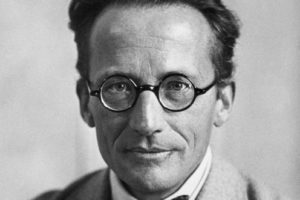
– Erwin Schrödinger
– Prof David Bohm
– Albert Einstein
Click on any event to view the recordings as well as event details